Description
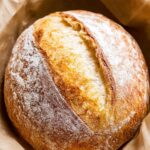
This Easiest Ever Sourdough Bread recipe is a no-knead, simple artisan bread perfect for beginners and seasoned bakers alike. Made with just a few ingredients including a mature sourdough starter, bread flour, water, and salt, this bread requires minimal hands-on effort but yields a crusty, golden loaf with a soft, airy interior. The process includes an overnight starter build, a long fermentation, gentle folding, and baking in a Dutch oven to achieve a professional bakery-quality crumb and crust at home.
Ingredients
Scale
Starter Build (Night Before)
- 25 grams mature starter (about 2 tablespoons)
- 75 grams unbleached bread flour or all-purpose flour (½ cup + 1 teaspoon)
- 75 grams water at 90°F (⅓ cup)
Dough
- 100 grams ripe starter (heaping ⅓ cup)
- 300 grams filtered water at 90°F (1¼ cups + 1 tablespoon)
- 500 grams white bread flour or unbleached all-purpose flour (3½ cups + ½ teaspoon)
- 10 grams sea salt (2⅛ teaspoons)
Instructions
- Build the Starter: The evening before baking, combine 25 grams mature starter with 75 grams flour and 75 grams warm water (90°F) in a clean mason jar. Mix thoroughly until no dry flour remains. Cover loosely with plastic wrap and let rest at room temperature for 8-12 hours. By morning, the starter should double in size and be full of bubbles, indicating it’s ripe and active.
- Mix the Dough: The next morning, in a large bowl, combine 100 grams of ripe starter with 300 grams of warm water (90°F). Stir until the starter is fully dispersed. Add 500 grams bread flour and 10 grams sea salt. Mix until a shaggy, sticky dough forms. Use your hands to gather it into a sticky ball; the texture should be rough and tacky.
- First Rise: Cover the bowl with plastic wrap and place it in the oven with the light on, creating a warm environment around 80-85°F. Let the dough rise for 5-6 hours until it is noticeably puffed and roughly doubled in size. When you gently poke the dough, it should leave an indentation that slowly fills back in.
- Shape the Dough: Lightly dust your counter with flour. Turn the dough out onto the surface with the smooth side down. Fold the dough by pulling the edges into the center from top, bottom, left, and right, pinching to seal. Repeat folds once more. Flip the dough seam-side down and use cupped hands to rotate and tighten it into a smooth, taut ball with a soft pliable surface.
- Second Rise: Dust a bread basket liberally with flour and place the dough seam-side up inside. Lightly dust the dough surface with flour to prevent sticking, then cover with plastic wrap. Return the basket to the oven with the light on for 2-3 hours until doubled in size and airy. The dough will hold an indentation when gently pressed.
- Preheat Oven and Prepare for Baking: Remove the dough from the oven and preheat your oven to 450°F. Note that the Dutch oven does not require preheating for this recipe. Place a sheet of parchment paper on the counter and gently transfer the dough onto it, seam side down. Score the top lengthwise about ½ inch deep with a sharp knife or lame in a decisive, clean cut exposing the pale dough underneath.
- Bake the Bread: Using the parchment paper corners, lift the dough into the Dutch oven. Cover with the lid and reduce the oven temperature to 425°F. Bake covered for 40 minutes. Then remove the lid and bake an additional 5-10 minutes until the crust turns a dark golden brown and sounds hollow when tapped.
- Cool Completely: Remove the bread using the parchment paper and place it on a cooling rack. Allow the bread to cool completely for at least 2 hours until the internal temperature reaches 190-205°F. Cooling fully ensures a crisp crust and fully set crumb. Slice and enjoy your homemade artisan sourdough bread!
Notes
- Active and bubbly starter is crucial; if your starter doesn’t float in water, it’s not ready to use.
- If you don’t have a proofing basket, a large bowl lined with a well-floured kitchen towel works well.
- The dough is naturally sticky during mixing, which is normal and helps achieve the perfect artisan texture.
- In colder kitchens, fermentation may take longer; using the oven light method provides gentle warmth to speed this up.
- Score the dough confidently with a sharp knife; hesitant cuts can cause uneven rising. Beginners can use a simple straight cut.
- While bread flour is ideal for best texture, all-purpose flour can be substituted with good results.
- Store baked bread at room temperature in a paper bag for up to 3 days. For longer storage, slice and freeze in an airtight container for up to 3 months.
Nutrition
- Serving Size: 1 slice (approx. 80g)
- Calories: 210
- Sugar: 1g
- Sodium: 400mg
- Fat: 1g
- Saturated Fat: 0.2g
- Unsaturated Fat: 0.6g
- Trans Fat: 0g
- Carbohydrates: 43g
- Fiber: 2g
- Protein: 7g
- Cholesterol: 0mg